
Story-Modeling is an approach to storytelling that answers questions presented by the storytelling boom.
When a story is a model.
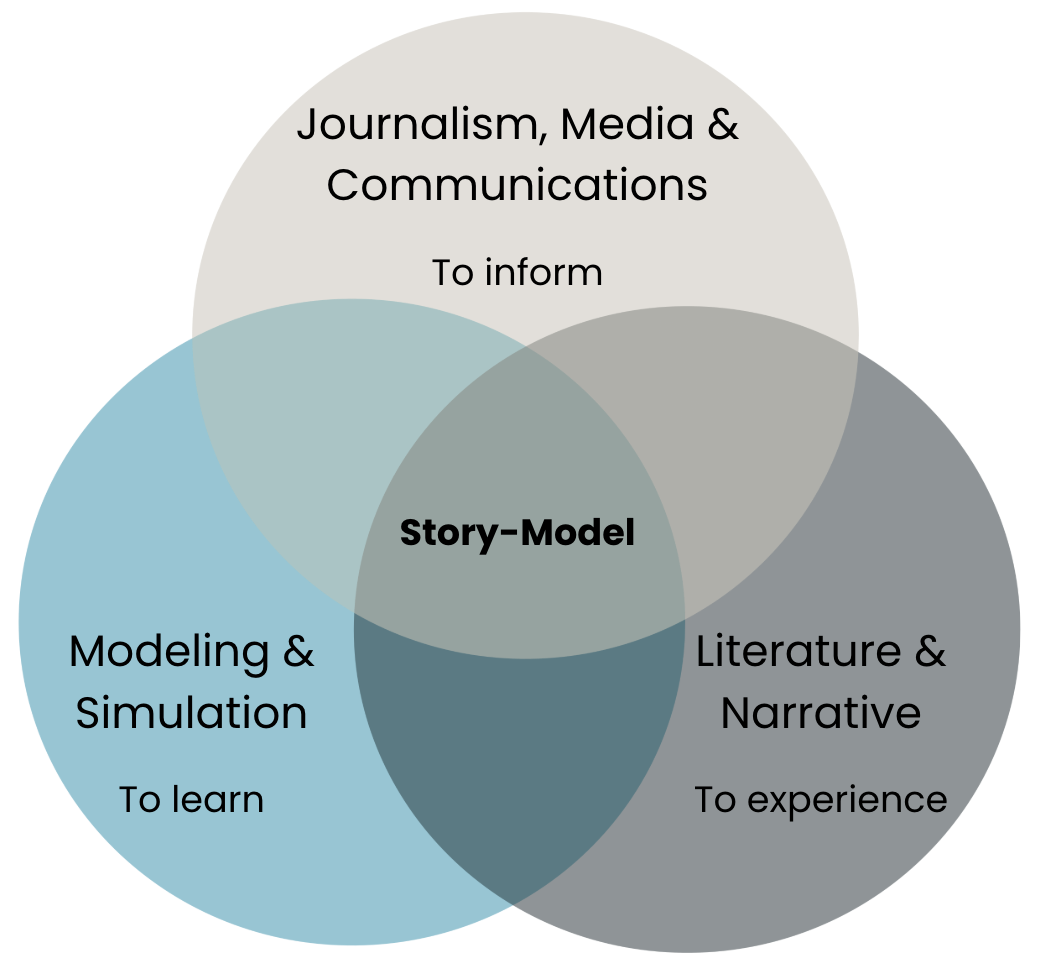
Questions raised by strategic storytelling in the storytelling boom have forced a deeper examination of the question: what is a story?
If a story is just a form of literature, why are we concerned when it’s about a real person?
If a story just communicates information, why are we concerned if it’s about a person who was helped by the storyteller?
The answer is found in what the story is used for.
In the storytelling boom, stories aren’t just told for enjoyment or to communicate information — they are told so that the audience can learn something about the real world by imagining the events in the story and predicting what will happen. When we use a story to learn something about the real world — the story is in fact a model.
Story-Modeling
Modeling & simulation is an established scientific discipline that has already had to find solutions to the kinds of questions raised by the storytelling boom:
How do we make sure that we don’t produce models that result in people creating an incorrect belief — or learning “the wrong thing”
How do we build models that are simple enough to be easy to understand, but don’t oversimplify an issue so as to be dangerous
Modeling and simulation practitioners have developed industry standards and best practices that we can use to guide us in the production of stories used to generate knowledge about the real world.
A Story-Model is a simulated scientific model of relational events about the real world.
Simulated: occurs over a period of time
Scientific: for the purpose of learning or generating knowledge
Model: representation of something else (“this represents that”)
Relational events: events that are related to each other
Real world: observed (not imagined)
Frequently Asked Questions
-
No.
Persuasion sits within a binary framework: there’s a “right” and “wrong” point of view, and the persuader’s effort is to shift the audience’s point of view to the “right” one.
Story-Modeling sits within a plurality framework: there are multiple points of view that are coherent or incoherent — and useful or not.
Persuasion is successful when the audience’s opinion is aligned with the persuader’s; Story-Modeling is successful when your audience is able to generates useful knowledge from your story.
-
Story-Modeling uses knowledge from narrative theory, modeling & simulation, and neuroscience to enable simulation learning.
The science is not new, but combining knowledge from these disciplines into a storytelling method is new.