
Ethical Issues
Journalism,
Media & Communications
Exploitation, Power + Benefit
Ethical storytelling is the practice personal storytelling in organizational communications with consideration to moral principles.
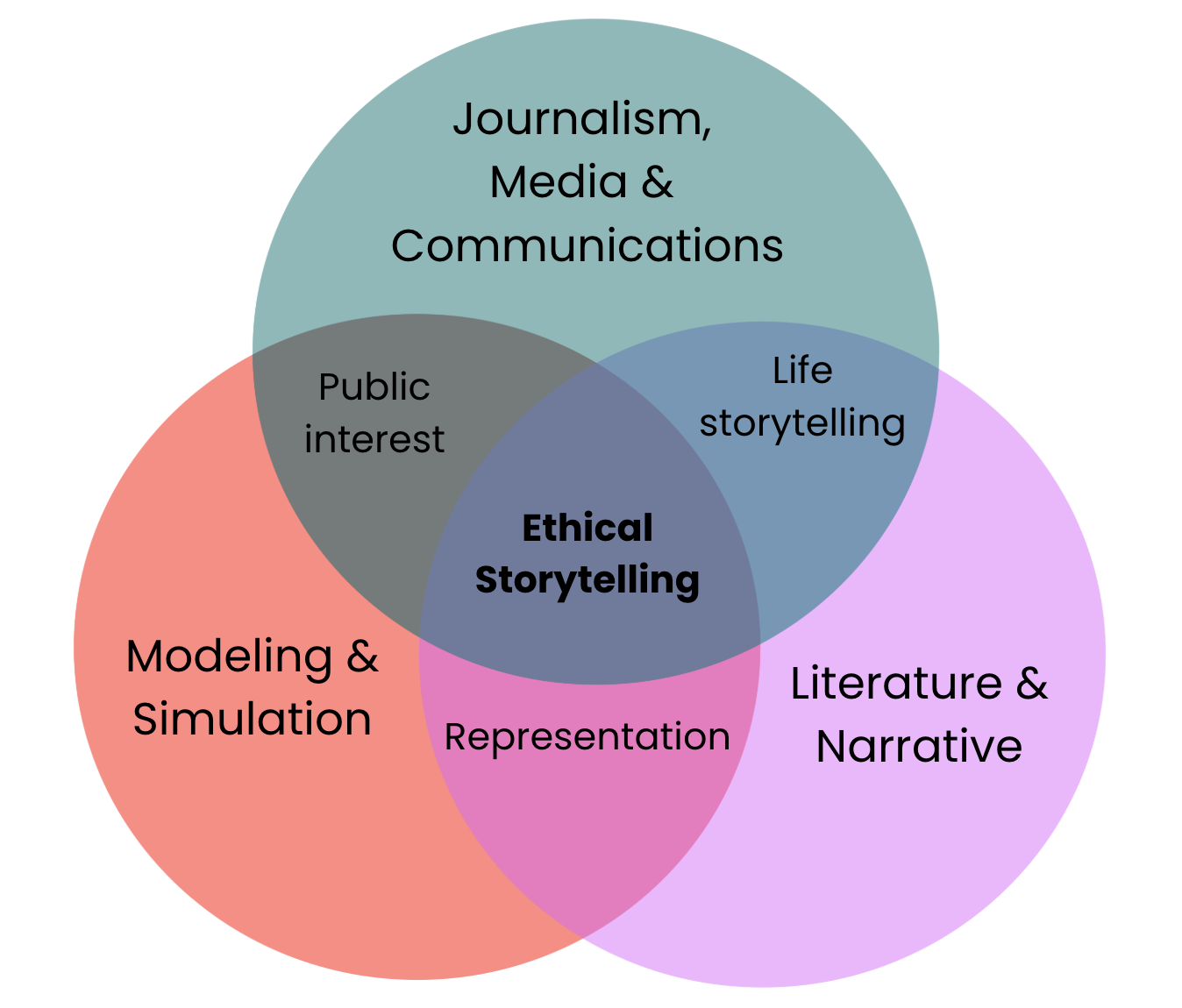
Ethical storytelling is multi-disciplinary.
While the interdisciplinary nature of organizational storytelling has created a new practice of producing narrative texts within organizational communications, this new practice has presented ethical questions that are not answered within the fields of Literature or Journalism, Media & Communications.
Simultaneously, the emerging discipline of Modeling & Simulation has been addressing ethical issues raised by the public use and social impact of models, in particular following the global financial crisis of 2008 and the COVID pandemic — both of which relied on models to make determinations such as financial risk or public health response.
When narrative and communications intersect at personal storytelling, a new intersectional practice is created; when that practice is measured against ethics, knowledge from an additional field can answer the questions that are generated.
Literature and narrative traditionally focuses on texts, while Journalism, Media & Communications traditionally focuses on their production and distribution. When the texts produced within organizational storytelling are considered as models, knowledge from the field of Modeling & Simulation presents insight and solution to the ethical issues of ethical storytelling.
Narrative
Modeling & Simulation
Other Considerations
Privacy
Agency + Ownership
Identity
Truth
Meaning
Communicator Impact
The right to privacy is well established legally and ethically. As a result, storytelling requires informed consent from all story participants. There are cases where this is unclear, such as the age of consent, consent when there are legally responsible adults, and consent when the story includes traumatic events.
The power imbalance between the story participant and the organization creates an ethical concern. Journalism has countered this by creating industry standards where journalists cannot receive anything from sources, however the organization benefits just by telling the story, without receiving any gift. The concern here is that a participant would be — or feel — exploited by participating in a story, and that the power imbalance impacts their ability to refuse consent freely.
In the reverse, were the organization to compensate the participant, it can create the perception that the story is “sponsored” — or an advertisement — rather than an accurate representation.
Compensating the subject for participating in the story creates a new ethical concern — compromising the integrity of the story, real or perceived — and therefore communications policies typically forbid compensation.
(It is worth noting that it is common practice to compensate someone for a personal story used in marketing material as a testimonial or endorsement, such as the customer of a product or service.)
By definition, there is a power imbalance between the subject and the narrator (organization): the organization has staff, funding, and status where the subject typically does not. The power imbalance cannot be corrected, however it can be reduced by increasing the subject’s power in the storytelling process through support.
While the right to privacy protects someone’s right not to tell their story, narrative agency protects their right to determine it. Personal agency is critical for story subjects, but ethical practice becomes more complex when a subject wants to tell a personal story that could be used weaponized against them. For example, a story about an undocumented immigrant could result in targeting by immigration authorities. Freedom of the press does not extend to communicators: where do personal agency and organizational responsibility meet?
Personal identity is constructed from the stories we tell ourselves — and are told. Someone’s identity can be impacted by stories told about them by others — including organizations — impacting both how others see them and how they see themselves.
When a personal story includes traumatic events, an additional responsibility of care is assumed by the narrator to minimize harm from possible retraumatization.
Truth and stories have a controversial relationship: historically, stories and nonfiction did not mix, however the separation has been dissolving since the rise of narrative journalism, narrative nonfiction and now social media.
The tension sits at the intersection of representation and verification: da story represents a personal experience, and a personal experience is impossible to verify. At this junction the controversy feeds itself: no-one can dispute someone’s experience — because it’s unknowable by anyone else — yet it cannot be verified either.
Modeling & Simulation has encountered a similar ethical issue with the truth of a model; in this field, the issue is resolved by categorizing a model as a representation — a thing with no relationship to truth. The famous quote “all models are false, but some are useful” helpfully shifts the question from “is it true?” to “is it a useful representation?”
We can never know definitively if the story someone tells aligns perfectly with their internal experience — and, people eventually begin experiencing the same difficulty with their own stories as memory is infamously unreliable.
Some impact storytelling has been criticized for reducing multi-dimensional people into two-dimensional characters, in service of a story. However, the very nature of representation is reduction; by representing stories as truth we create an ethical issue rather than solving one.
Storytelling is the most powerful tool we have for sharing human experience.
“It’s just a story” is something said to minimize the value of the meaning of a story.
Modeling & Simulation takes on greater responsibility for the meaning created by representations by acknowledging that modeling is by nature biased, and that they are created to help people make decisions.
It is impossible to anticipate all possible future impacts of personal storytelling. Therefore, it is important to consider possible negative impacts that can be anticipated — as well as those that cannot (for example “I might regret telling this story in the future for reasons I have no way to predict today, such as future personal circumstances that I have no reason to anticipate”).
Hearing and retelling stories that include suffering — in particular violence and trauma - can have an impact on communicators’ mental and emotional health. Typically, communicators do not receive support from employers to counter these effects, however it should be considered.